For many Western fans of Japanese Adventure Games (J-AVGs), names like Fate/stay night or Steins;Gate represent the pinnacle of visual novel storytelling. However, deep in the history of the genre lies a forgotten pioneer that perfected the “reincarnation suspense” subgenre years before the modern boom.
That game is Kuon no Kizuna (久遠の絆), released in 1998 by the legendary developer FOG (Full On Games). Originally released for the PlayStation 1, this game remains an untranslated holy grail for core visual novel enthusiasts.
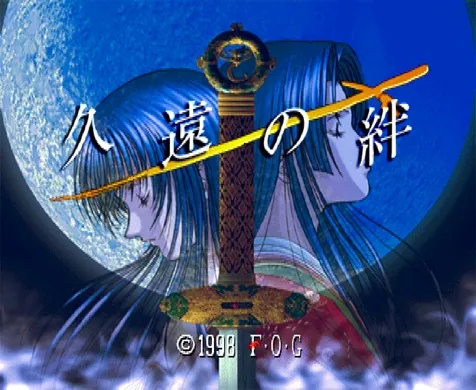 Kuon no Kizuna, FOG, PlayStation, 1998
The Hook: A 1,000-Year Cycle of Tragic Love and Curses
Unlike typical high school romance visual novels of the late ’90s, Kuon no Kizuna is a dark, epic narrative that seamlessly weaves together four distinct eras of Japanese history:
- The Heian Period (平安時代): The origin of the tragedy, involving Onmyodo (cosmic dualism), gods, and a cursed bloodline.
- The Genroku Period (元禄時代): The golden age of the Edo period where the reincarnated souls meet once again.
- The Bakumatsu Era (幕末): The chaotic final days of the Samurai.
- The Modern Day (現代): The current era where the protagonist must finally break the thousand-year cycle of death.
The protagonist, a seemingly ordinary high school student, begins having vivid nightmares of his own brutal deaths in past lives. When a mysterious transfer student arrives carrying a tragic aura, the gears of fate begin to turn again.
Meet the Bound Souls (Spoiler-Free Character Highlights)
The narrative revolves around several key heroines, each tied to the protagonist’s past lives. Understanding their connection is key to breaking the curse:
- Takahara Mayou (高原万葉): The mysterious transfer student. Her cold demeanor hides a thousand years of accumulated sorrow. She holds the ultimate key to the Heian period’s original sin.
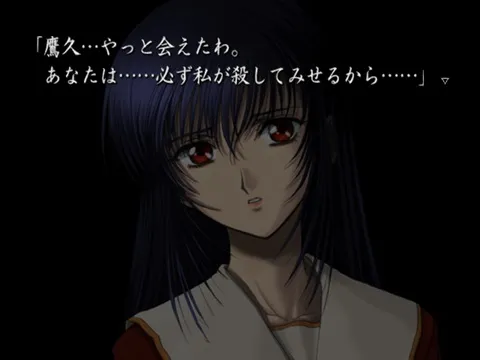 Mayou’s melancholic gaze perfectly embodies the game’s Y2K anime aesthetic.
- Itsuki Shiori (斎栞): The protagonist’s childhood friend in the modern day. In past lives, her counterpart was often caught in the crossfire of political factionalism, representing the innocent souls dragged into the cycle.
- Amano Satoko (天野聡子): The president of the school’s occult club. She has a calm demeanor and mysterious powers that guide the protagonist.
Why It’s a Masterpiece (The J-AVG Cult Perspective)
Hardcore Cultural Immersion & Grand Scale
Kuon no Kizuna does not spoon-feed its audience. The narrative relies heavily on actual Japanese mythology, Shintoism, Buddhist philosophy, and historical figures. The scale of this story—spanning a literal millennium linked together by a single continuous narrative—is something uniquely Japanese. The plot does not just use history as a backdrop; it weaves the very foundation of Japanese folklore into the curse itself. For Western readers, it offers a fascinating, deep dive into the occult side of Japanese history that few translated games ever touch.
The Mastery of Reincarnation: Same Soul, Different Lives
What makes the game truly exceptional is how it handles its characters across the millennium. In each of the four eras, the same souls are reincarnated. Yet, they are not carbon copies. Their ages, social standings, and subtle personality traits change based on the era they live in.
And yet, as a reader, you can profoundly feel the “essence of their souls” remaining identical. The core fears, the tragic attachments, and the unyielding bonds of love transcend time. Witnessing how a character’s core nature manifests differently in the Heian period versus the Bakumatsu era is a masterclass in psychological character writing. While some of these cultural nuances might be easier to appreciate if you grew up in Japan, the emotional weight of this 1,000-year struggle is universal.
High-Stakes Decisions & The Invisible “E’s Reaction” System
In many retro visual novels, the difficulty comes from hidden “landmine” choices that instantly trigger a Bad End. Kuon no Kizuna takes a much more insidious approach. It is actually quite forgiving when it comes to soft-locking you out of a route; the game features a subtle rubber-band system that allows you to recover from a few bad mistakes if your subsequent choices are flawless.
The real terror lies in its unique “E’s Reaction System.” From the very first minute of the game, a complex web of affection points is constantly calculated in the background. What makes this system notorious among J-AVG veterans is that characters’ emotions change based on your choices even when they aren’t present in the scene. A seemingly minor decision regarding your childhood friend in the morning can quietly alienate the mysterious transfer student by the afternoon.
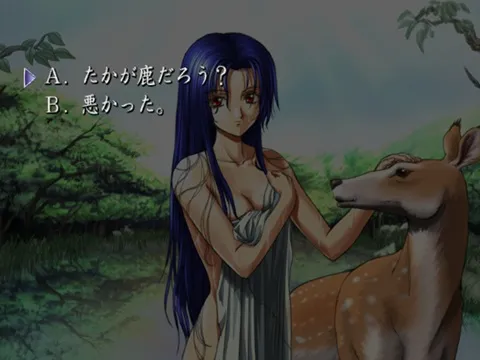 The historic first meeting between Takahara Mayou’s past life (Hotaru) and the protagonist.
Instead of dodging instant-death flags, Kuon no Kizuna demands absolute emotional consistency across all four eras. If you treat your choices lightly, you will find yourself at the final chapter’s critical junction, agonizing over a choice where no option can save the soul you intended to protect. It is a slow-burning mental puzzle that makes a dedicated strategy guide almost mandatory for a true clear.
The Haunting Y2K Aesthetic & Soundscape
The PS1 and Dreamcast versions feature beautifully detailed hand-drawn 2D sprites and atmospheric 90s anime character designs. The lo-fi visual fidelity gives it a timeless, eerie atmosphere that modern high-definition visual novels often fail to replicate.
Complementing this visual style is a profoundly melancholic, bittersweet traditional Japanese soundtrack composed by the legendary Kazami Saga (風水嵯峨). Deeply rooted in traditional instrumentation, his compositions—especially the haunting main theme—perfectly echo the tragic history of the characters. Saga’s mastery lies in blending the eerie stillness of ancient Shinto rituals with the emotional weight of a modern drama. It is the kind of music that lodges itself into your brain; it is hauntingly memorable, and you will find yourself wanting to listen to it on repeat long after you turn off the game. This unique soundscape heavily carries the eerie, beautiful Y2K aesthetic that defines FOG’s golden era.
The Masterminds Behind the Legend
To understand the depth of Kuon no Kizuna, one must look at the creators. The scenario was penned by Katou Naoki (加藤直樹), who crafted a narrative so tightly woven that even minor choices in the modern era ripple back to actions taken 1,000 years ago.
Complementing this tale of eternal reincarnation is the artwork by Kishiue Daisaku (岸上大策). At just 25 years old, his character designs perfectly capture the late-90s anime aesthetic—sharp, elegant, and deeply expressive—evoking a sense of melancholy that fits the game’s theme of eternal tragic love. This breakout success established him as a cornerstone of the developer, FOG, where he went on to shape the company’s visual identity by handling the artwork for nearly all of their subsequent titles.
Historical Impact & The “FOG” Legacy
This title established FOG as a studio that cared deeply about unconventional mechanics and heavy atmosphere. It proved that text-based adventures could tell stories with the scope of a grand historical fantasy novel.
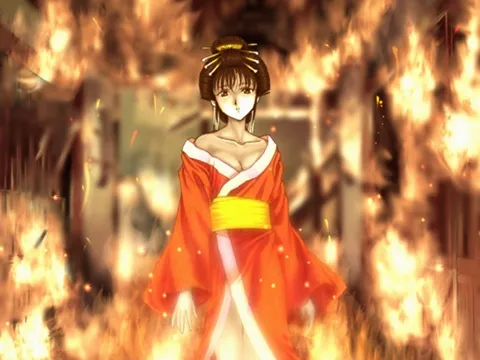 Facing the flames of destiny. A cinematic testament to FOG’s masterful, sweeping historical fantasy.
If you are a fan of Tsukihime or Higurashi When They Cry, Kuon no Kizuna is the direct spiritual ancestor you need to know about. It is a masterpiece that I deeply, passionately want Western players to experience.
What’s Next? Ready to Experience the Myth?
Now that you know why Kuon no Kizuna is an absolute masterpiece of the J-AVG genre, you might be wondering how you can actually play it today. Despite being completely untranslated, there are multiple ways to dive into this 1,000-year tragedy.
→ Proceed to Part 2: Kuon no Kizuna English Play Guide: Versions & Translation Setup